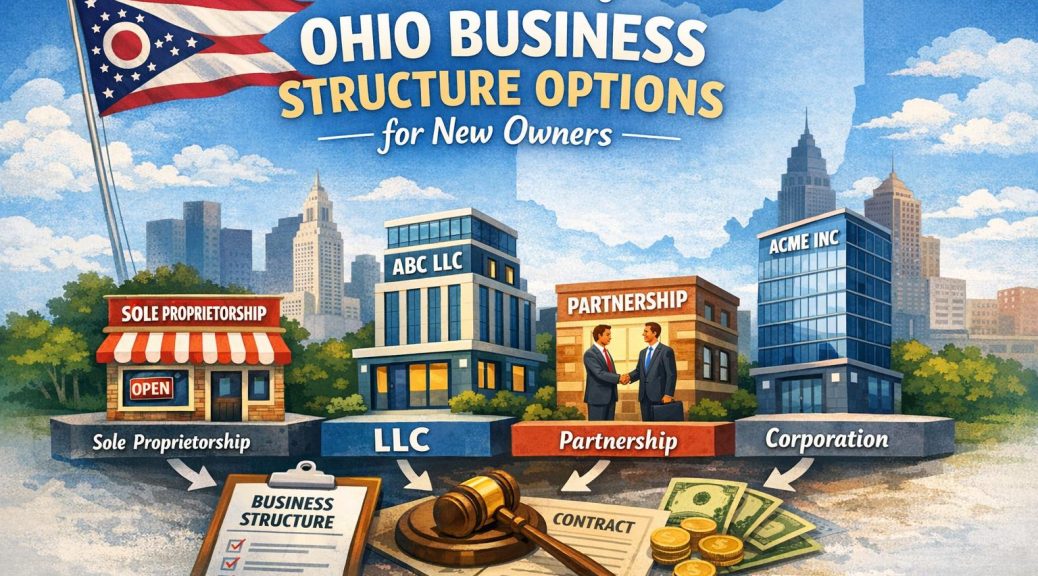
Understanding Ohio Business Structure Options for New Owners
Understanding Ohio Business Structure Options for New Owners
When establishing a business in Ohio, selecting an appropriate legal structure is one of the most important early decisions a new owner will make. A business structure determines how the enterprise is recognized under state law, how it is taxed, the extent of personal liability faced by the owners, and how management authority is organized. The structure chosen at formation can influence fundraising opportunities, reporting obligations, continuity of the business, and even long-term succession planning.
Ohio law provides several recognized forms of business organization, each designed to accommodate different operational needs and risk profiles. While it is possible to change a structure later, doing so may involve additional filings, tax consequences, and administrative complexity. For this reason, new owners should understand the practical and legal distinctions among the available options before registering their business with the Ohio Secretary of State.
Sole Proprietorship
A sole proprietorship is the most straightforward business structure available in Ohio. It exists whenever an individual engages in business activities without forming a separate legal entity. Because there is no legal distinction between the owner and the business, the sole proprietor has complete control over decision-making, operations, and profits.
Formation of a sole proprietorship does not require filing formation documents with the state. However, depending on the type of business, the owner may need local licenses, professional permits, or a trade name registration if operating under a name different from the individual’s legal name. If a trade name is used, it must be registered with the Ohio Secretary of State to provide public notice of the business identity.
One defining characteristic of a sole proprietorship is personal liability. The owner is personally responsible for all debts, obligations, and liabilities incurred by the business. If the business cannot meet its financial obligations, creditors may seek repayment from the owner’s personal assets, including bank accounts or property. This exposure is a significant consideration, particularly in industries with higher operational risks.
From a tax perspective, sole proprietorships are not taxed separately from their owners. Business income and expenses are reported on the owner’s individual federal and state income tax returns. This pass-through taxation simplifies tax filings compared to more formal entities. However, sole proprietors are also responsible for paying self-employment taxes on net earnings.
The sole proprietorship structure is often appropriate for small-scale or low-risk ventures where administrative simplicity and direct control are priorities. It may also serve as a temporary structure during early-stage operations before transitioning into a more formal entity as the business grows.
Partnership
A partnership is formed when two or more individuals or entities agree to operate a business for profit as co-owners. In Ohio, partnerships can arise automatically through conduct, even without formal registration. However, formalizing the partnership through registration and a written agreement reduces uncertainty and clarifies expectations among participants.
Ohio recognizes several forms of partnerships, including general partnerships, limited partnerships, and limited liability partnerships. Each variation allocates liability and management authority differently.
General Partnership (GP)
In a general partnership, all partners share responsibility for managing the business and are personally liable for its debts and obligations. Each partner has the authority to bind the partnership in contracts and business dealings, unless otherwise agreed. This mutual agency creates flexibility but also increases risk, as one partner’s decisions may legally obligate the others.
Unless otherwise stated in a written agreement, profits and losses are typically shared equally, regardless of the amount of capital contributed by each partner. For tax purposes, a general partnership is generally treated as a pass-through entity. The partnership files an informational return, and income or loss passes through to the partners’ individual tax returns.
A written partnership agreement is strongly recommended. It should define contributions, decision-making procedures, dispute resolution mechanisms, procedures for admitting new partners, and terms for dissolution.
Limited Partnership (LP)
A limited partnership consists of at least one general partner and one or more limited partners. The general partner manages the business and retains personal liability for partnership obligations. Limited partners typically do not participate in day-to-day management and have liability limited to their investment in the partnership.
To establish an LP in Ohio, a Certificate of Limited Partnership must be filed with the Secretary of State. This formal registration distinguishes the entity from a general partnership and provides notice of its structure.
Limited partnerships are often used for investment-oriented ventures or projects where passive investors wish to contribute capital without assuming operational control or full liability. The structure allows flexibility in allocating profits and losses, which can be defined in the partnership agreement.
Limited Liability Partnership (LLP)
A limited liability partnership is commonly used by professionals such as attorneys, accountants, and consultants. In an LLP, partners are generally shielded from personal liability for certain partnership debts and for misconduct committed by other partners.
To qualify as an LLP in Ohio, the partnership must register with the Secretary of State and comply with statutory requirements. While partners remain responsible for their own actions, the LLP structure provides enhanced protection compared to a general partnership.
Partnerships of all types benefit from clear governance documents and defined financial arrangements. Without explicit agreements, Ohio’s default statutory provisions may govern internal matters, which may not reflect the partners’ intentions.
Limited Liability Company (LLC)
The limited liability company, or LLC, is a widely chosen business structure in Ohio due to its combination of liability protection and operational flexibility. An LLC is a separate legal entity formed by filing Articles of Organization with the Ohio Secretary of State.
The primary advantage of an LLC is that its members are generally not personally liable for business debts and obligations. Their financial risk is typically limited to their capital contributions. This liability shield makes the LLC structure suitable for many small and mid-sized businesses.
LLCs may be managed by their members or by appointed managers. This flexibility allows new owners to tailor governance according to their operational needs. The internal rules of the entity are typically set forth in an Operating Agreement. Although Ohio does not require LLCs to have a written Operating Agreement, establishing one is highly advisable. It defines ownership percentages, voting rights, profit distributions, and procedures for resolving disputes or transferring membership interests.
From a tax standpoint, LLCs benefit from default pass-through taxation. A single-member LLC is generally treated as a disregarded entity for federal tax purposes, meaning income is reported directly on the owner’s return. Multi-member LLCs are typically taxed as partnerships. However, LLCs also have the option to elect taxation as a corporation, including S corporation status, if it aligns better with strategic tax objectives.
LLCs require fewer formalities than corporations. There is no statutory requirement for annual meetings or extensive recordkeeping, although prudent management includes maintaining financial records and observing separation between personal and business activities. Maintaining this separation is essential to preserving the liability shield.
The LLC structure is often appropriate for businesses seeking liability protection without the administrative requirements associated with corporations. Its adaptability makes it suitable across diverse industries, from real estate to retail and professional services.
Corporation
A corporation is a distinct legal entity owned by shareholders. Incorporating in Ohio requires filing Articles of Incorporation with the Secretary of State and complying with statutory formalities. Corporations are often selected by businesses anticipating substantial growth, investment from external shareholders, or complex organizational structures.
One of the defining characteristics of a corporation is limited liability. Shareholders are generally not personally liable for corporate debts or obligations beyond their investment in stock. The corporation itself is responsible for contractual obligations, litigation liabilities, and financial commitments.
Corporations have a more structured governance framework than other entities. Shareholders elect a board of directors, which sets strategic direction and appoints officers responsible for day-to-day operations. Ohio law imposes formal requirements, including maintaining corporate bylaws, holding annual shareholder and director meetings, documenting meeting minutes, and keeping corporate records.
C Corporation
A C corporation is the default tax classification for corporations. Under this structure, the corporation is taxed as a separate entity. Profits are subject to corporate income tax, and if those profits are distributed as dividends, shareholders pay taxes on the distribution. This system of taxation is commonly referred to as double taxation.
Despite this tax structure, C corporations offer advantages in certain circumstances. They allow unlimited numbers and types of shareholders and can issue multiple classes of stock. These characteristics make C corporations attractive to businesses seeking venture capital funding or planning eventual public offerings.
S Corporation
An S corporation is not a separate type of legal entity but a tax election available to qualifying corporations and certain LLCs. By electing S corporation status, the entity avoids corporate-level taxation, and income passes through to shareholders’ individual tax returns.
To qualify for S corporation status, the business must adhere to strict eligibility criteria imposed by the Internal Revenue Service, including limits on the number and type of shareholders and restrictions on stock classes. While these limitations reduce structural flexibility, S corporation status can provide tax efficiencies for certain closely held businesses.
Key Factors in Choosing a Structure
When evaluating business structures, new owners in Ohio should consider liability exposure, tax treatment, management preferences, compliance obligations, and long-term growth plans. A low-risk, single-owner venture may prioritize simplicity and minimal filings, while a multi-owner company with growth ambitions may prioritize liability protection and capital-raising capacity.
Administrative requirements also vary significantly. Sole proprietorships and general partnerships involve minimal formalities, whereas corporations must adhere to statutory governance practices. LLCs occupy an intermediate position, providing liability protection with reduced formal structure.
Taxation can influence net profitability and cash flow. Pass-through structures avoid entity-level taxation but may subject owners to self-employment taxes. Corporate structures may offer more flexibility in compensation planning and retained earnings strategies, depending on circumstances.
Registration and Compliance in Ohio
Most formal business entities must file formation documents with the Ohio Secretary of State and pay associated filing fees. Businesses must also appoint a statutory agent to receive legal notices and service of process. Maintaining current information with the state is essential to preserving good standing.
In addition to formation filings, businesses may need federal and state tax identification numbers, sales tax permits, employer registrations, and industry-specific licenses. Compliance with zoning laws and municipal regulations may also apply.
After formation, ongoing obligations vary by structure. Corporations must maintain corporate records and meeting minutes. LLCs and partnerships should maintain internal agreements and financial documentation. All businesses must adhere to tax filing requirements and employment laws if they hire workers.
Conclusion
Selecting a business structure is a foundational step for new business owners in Ohio. Each available option—sole proprietorship, partnership, limited liability company, or corporation—carries distinct legal, financial, and administrative implications. Simpler structures offer ease of formation but may expose owners to greater personal liability. More formal entities provide liability protection and structural flexibility but require adherence to regulatory requirements.
The appropriate choice depends on the business’s size, risk profile, ownership composition, and growth objectives. Careful evaluation at the outset can reduce complications later and support stable operations. Many owners consult legal and tax professionals to align their structure with both immediate operational needs and long-term strategic plans.
For more information on starting a business in Ohio, visit the official Ohio government website.