Ohio
Located in the Great Lakes region of the United States, Ohio links the Northeast with the Midwest and is affectionately known as “The Heart of It All” state. Of the fifty states, it is only on place 34 by size, by still has the seventh-largest population.
Ohio is named after the Ohio River, which runs along its southern border, and which is the second largest river by discharge volume in the United States. In the Seneca language, ohiːyo’ means good/great/large river or creek. Even though Ohio is bounded by the river, most of it belongs to Kentucky and West Virginia.
Located partly in and partly west of Appalachia, Ohio was a part of the Northwest Territory in the early frontier, before joining the Union in 1803. In the 20th century, the state became heavily industrialized, with a lot of manufacturing taking place here.
Politically, Ohio is known to be a swing state and is considered a bellwether in national elections.
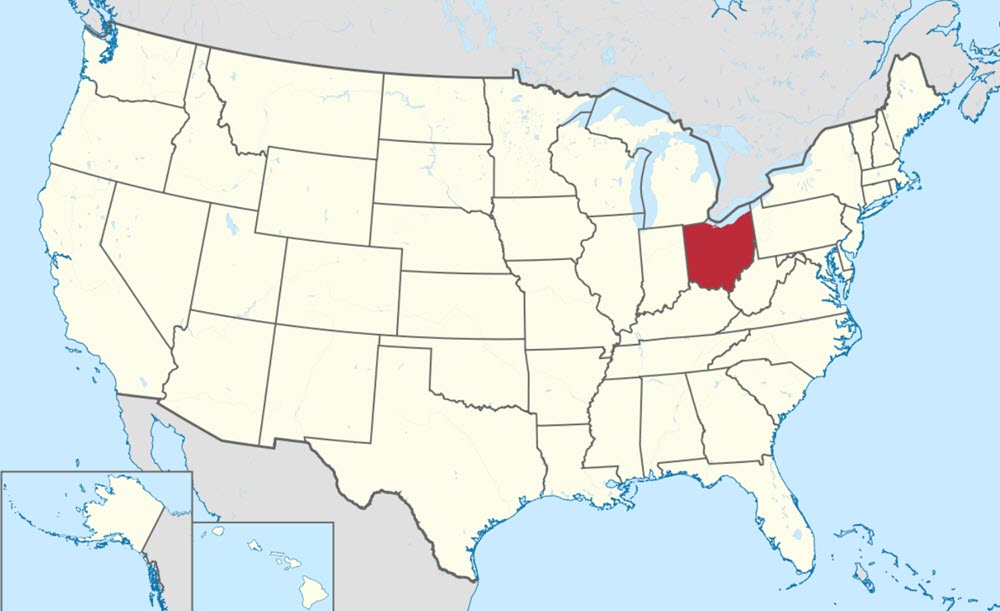
Where is Ohio?
Ohio is a Midwestern state.
It is bordered by:
- Lake Erie to the north
- Pennsylvania to the east
- West Virginia to the south-east
- Kentucky to the south
- Indiana to the west
- Michigan to the north-west
What’s the capital of Ohio?
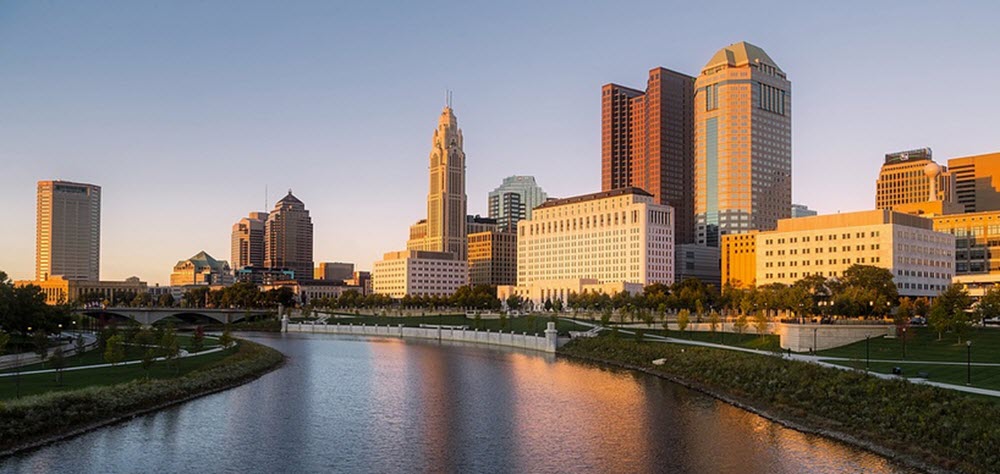
Columbus is both the capital and most populous city in Ohio.
Short facts about Ohio
- Country: USA
- Area: 44,825 sq mi (116,096 km2)
- Highest elevation: Campbell Hill, at 1,549 ft above sea level
- Population: Almost 11.7 million in 2018
- Capital: Columbus
- Majority language: English, spoken by over 90% of the population
- Largest minority language: Spanish
- Time zone: UTC -05:00 (Eastern), UTC-04:00 (Eastern Daylight Time)
- ISO 3166 code: US-OH
- USPS abbreviation: OH
Geography
Ohio consists of five distinct geographical regions:
- The glaciated Allegheny Plateaus region in the north-east.
- The unglaciated Allegheny Plateaus region which forms the rest of the eastern part of the state. While most of Ohio is of low relief, this part of the state is characterized by rugged hills, and there is a lot of forest remaining here.
- The large Till Plains in central and western Ohio, a typical Central Lowland region.
- The Huron-Erie Lake Plains in the north, which dominates the north-west.
- A small sliver of interior low plateau by the southern border, known as the Bluegrass Section.
Transportation
Ohio’s geographical location – connecting the Northeast to the Midwest, and with a multitude of navigable rivers and lakes – proved important for its development in the 19th and early 20th century. During the first half of the 19th century, the waterways were expanded through a series of canal project which proved commercially successful, and several cities – including Dayton – largely owe their industrial development to the presence of these canals.
A lot of cargo and business traffic still passes through Ohio, but highways have become more important that canals. Ohio is within a one-day drive of 50% of North America’s population and within a one-day drive of 70% of North America’s manufacturing capacity.
The cargo ports on Lake Erie in the north are still very important for bulk freight and the manufacturing industry.
East-west highways and roads
Ohio has a well-developed and maintained network of intrastate and interstate highways, and both U.S Route 30 and U.S. Route 40 runs through Ohio. The state links the Northeast with the Midwest, and several large east-west transportation corridors run through the state. When one of its old pioneer routes was selected to become a part of the new Lincoln Highway (connecting New York City with San Francisco) in the early 20th century, it had a major impact on the development of the state. Today, the highway is known as U.S. Route 30.
In the north, you can travel east-west through Ohio on the Ohio Turnpike (I-80/I-90). The I-76 runs through Akron to Pennsylvania, I-70 through Columbus and Dayton, and the Appalachian Highway from West Virginia to Cincinnati.
East-west highways and roads
Examples of major north-south routes through Ohio:
- The I-75 in western Ohio, which goes through Toledo, Dayton, and Cincinnati. The stretch that connects Dayton with Cincinnati is one of the most heavily traveled section of interstate in the whole state.
- The I-71 in the center of the state, which goes from Cleveland through Columbus and Cincinnati, before reaching Kentucky.
- The I-77 in the eastern part of Ohio, which goes from Cleveland through Akron, Canton, New Philadelphia, and Marietta, before entering West Virginia.
Day trading in Ohio
Financial activities is one of the two largest contributors to the GDP of Ohio. There are plenty of financial services companies in the state, but there are also plenty of private individuals that make their living form day trading and other financial activities such as Forex trading, CFD trading, binary options trading, and stock trading. Day traders still make up a very small percentile of all professionals in the state but day trading is becoming ever more popular. More and more people discover the allure of earning money day trading from home. Read this information on how to day trade if you want to try day trading.
Day trading requires a lot of effort and is not an easy way to make money. Do not try it if you are not willing to work hard.
Air travel
The four main international airports in Ohio:
|
Airport name |
FAA |
IATA |
ICAO |
City served | Enplanements
(2016)* |
|---|---|---|---|---|---|
| Cleveland-Hopkins
International Airport | CLE | CLE | KCLE | Cleveland | 4,083,476 |
| John Glenn Columbus
International Airport | CMH | CMH | KCMH | Columbus | 3,567,864 |
| James M. Cox Dayton
International Airport | DAY | DAY | KDAY | Dayton | 1,019,922 |
| Rickenbacker
International Airport | LCK | LCK | KLCK | Columbus | 102,751 |
* Number of commercial passenger boardings in the year 2016.
Important:
- A lot of traffic into The Greater Cincinnati Metropolitan Area uses the Cincinnati/Northern Kentucky International Airport in Hebron, Kentucky. While technically not located in Ohio, it is still a very important hub for air travel to and from Ohio.
- The Mid-Ohio Valley Region Airport serves the Marietta area of Ohio, even though the airport is located in West Virginia.